
If you’ve ever adjusted the speed on an orbital shaker and still didn’t get the mixing you expected, you’re not alone. Most mixing issues don’t come from the equipment, but from how the motion is understood.
What Are Orbital Shakers?
Orbital shakers move platforms in a circular motion to mix samples evenly without violent agitation. Instead of shaking back and forth, the platform follows a consistent round path. This motion gently moves liquid around the vessel, helping contents mix while keeping cells, cultures, or suspended materials intact.
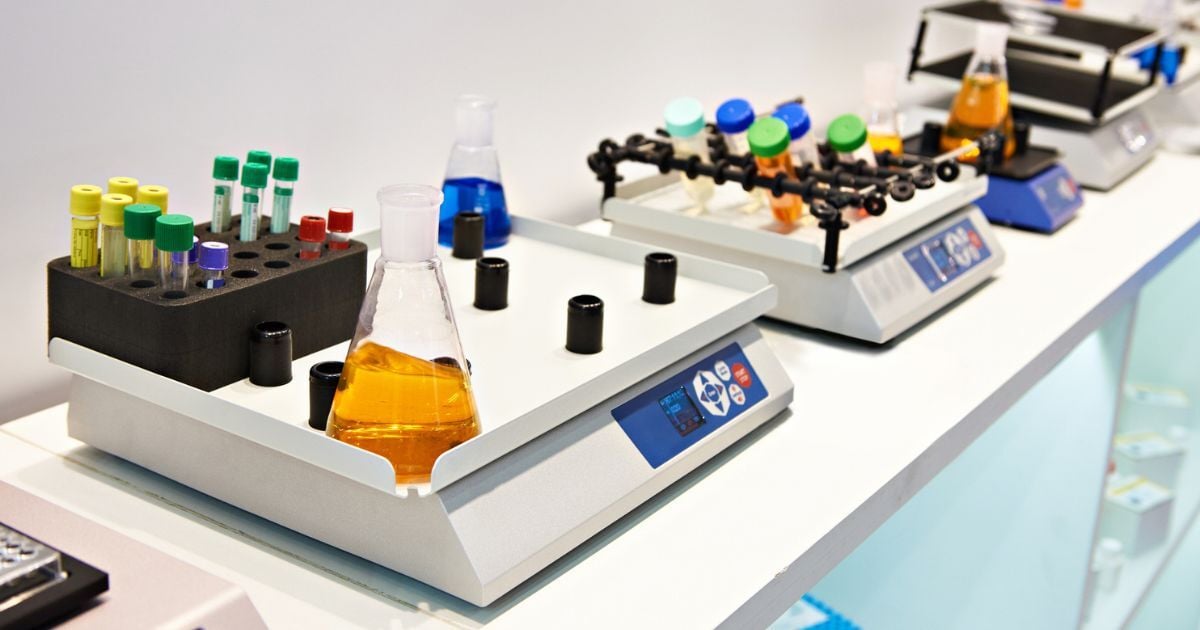
Samples sit on a flat platform that moves as a single unit. Labs often secure containers with clamps, spring racks, or rubber mats to keep vessels stable during operation.
You’ll commonly see orbital shakers used with:
- Erlenmeyer flasks for microbial or cell cultures
- Media bottles used in mixing and sample preparation
- Microplates or culture plates for screening or assays
- Test tubes or small vials placed in specialized racks
Because of this flexibility, orbital shakers are used across many workflows, including microbiology, molecular biology, chemistry, and extraction labs.
Orbital shakers also come in several sizes. Bench-top units are compact and fit easily on a lab bench for daily mixing tasks. Larger floor or stackable systems can handle heavier loads or multiple platforms, enabling labs to process many samples at once.
Why Orbital Motion Works
Orbital motion works because it creates a steady, predictable flow of fluid inside the container. Instead of forcing liquid back and forth, the platform moves in a smooth circular path. This motion causes the liquid to rotate along the vessel wall, forming a continuous swirling pattern.
That steady movement helps mix samples evenly without sudden shocks to the contents. For many applications, especially cell culture or biological samples, this kind of gentle motion matters.
Circular motion also reduces splashing. In reciprocating shakers, the platform moves side to side and stops abruptly at each end of the stroke. Those quick directional changes cause liquid to slosh or hit the vessel walls. With orbital shakers, the platform never stops or reverses direction. The motion remains smooth and continuous, helping keep liquids stable inside the container.
You’ll also see benefits when working with flasks. As the liquid moves around the walls of the vessel, it creates a thin surface layer that repeatedly exposes the sample to air. This helps promote oxygen transfer, which is important for microbial cultures and many biological processes.
Another advantage is suspension control. Orbital motion keeps particles, cells, or reagents evenly distributed throughout the liquid. Instead of settling at the bottom, materials remain suspended as the liquid circulates.
What Actually Controls Mixing in Orbital Shakers (It’s Not Just Speed)
Mixing in orbital shakers doesn’t depend solely on speed. It comes from how speed and motion work together to move liquid inside the container. Once you understand that relationship, it becomes much easier to choose the right settings and equipment.
Speed (RPM) Controls How Fast Liquid Moves
RPM controls how quickly the platform completes each circular rotation. As speed increases, the liquid inside the vessel moves faster along the walls.
This affects:
- How quickly materials circulate
- How much shear force is applied
- How often the liquid is exposed to air
Higher RPMs improve mixing speed, but they also increase stress on sensitive samples.
Orbit Diameter Controls How Far Liquid Travels
Orbit diameter controls the size of the circular path. A larger orbit means the liquid travels farther during each rotation, creating stronger motion inside the vessel.
This influences:
- How much the liquid “rolls” along the container wall
- How much energy is transferred into the sample
- How aggressively materials are mixed or kept in suspension
Smaller orbits create more controlled, gentle motion. Larger orbits create more noticeable fluid movement, even at lower speeds.
Mixing Comes From the Combination of Both
You can think of this as the Motion–Speed Relationship. Mixing intensity comes from the combination of speed and orbit diameter, not from either one alone.
A shaker with a large orbit at moderate speed can create stronger mixing than a high-speed shaker with a small orbit. Increasing speed without proper setup will not fix poor load distribution or unstable vessels.
When evaluating orbital shakers, focus on how these two factors work together. This is what creates consistent, controlled mixing.
When Should You Use Orbital Shakers?

You’ll often see orbital shakers used in applications where uniform suspension, gentle agitation, and consistent mixing are important.
Some of the most common use cases include:
- Cell culture – Orbital motion helps evenly distribute nutrients while improving oxygen exposure in culture media.
- Bacterial growth – Microbial cultures often rely on constant mixing to maintain oxygen transfer and prevent cells from settling.
- Solubility testing – When testing how materials dissolve in liquids, steady mixing helps maintain contact between the solvent and the material being tested.
- Staining procedures – Many staining workflows require slow, even agitation so solutions contact the entire sample surface.
- Mild chemical mixing – Orbital shakers are useful for keeping solutions evenly blended while avoiding excessive shear or foaming.
When You Also Need Temperature Control
In some workflows, temperature control is also important. That’s where shaking incubators come in.
Shaking incubators use the same circular motion as orbital shakers, but they add a temperature-controlled chamber. This allows your samples to mix while staying within a set temperature range.
You’ll typically need this setup when working with:
- Cell cultures that require stable growth conditions
- Bacterial or microbial cultures that depend on consistent temperature
- Fermentation or incubation processes where both mixing and heat control matter
If your process depends on both motion and temperature, a standard orbital shaker alone will not be enough.
When Orbital Shakers Are Not the Right Tool
Orbital shakers are not always the right solution for every mixing task. Some applications require stronger mechanical force than orbital motion can provide. Understanding their limits helps you choose equipment that matches the job.
- Heavy slurry mixing – Slurries with large particles or dense solids need stronger agitation to keep materials suspended. Orbital motion may move the liquid, but heavier particles can still settle at the bottom.
- High-viscosity materials – Thick liquids move differently than water-based solutions. Materials such as syrups, gels, or concentrated suspensions resist the smooth circulation created by orbital motion.
- Large-scale production blending – Orbital shakers are typically used for small to moderate volumes in flasks, bottles, or plates. When mixing moves into production-scale tanks or reactors, larger mixing systems are needed to maintain consistent flow and agitation.
- Aggressive emulsification – Some processes require strong shear to break liquids into fine droplets and form stable emulsions. Orbital shakers create circulation, but they do not generate the intense turbulence needed for this type of mixing.
When equipment matches the demands of the process, experiments run more consistently, and results become easier to repeat.
Common Mistakes When Selecting Orbital Shakers
Choosing the right shaker involves more than looking at the maximum speed or platform size. Many labs run into problems because a few important details are overlooked during selection. Understanding these common mistakes will help you choose a shaker that performs reliably in daily use.
Ignoring Total Load Capacity
Every shaker has a maximum load rating. That limit includes everything placed on the platform. It’s easy to focus only on the vessels, but the total load includes:
- The platform itself
- Clamps or racks
- The vessels you’re using
- The weight of the liquid inside them
For example, several filled flasks add significant weight quickly. If the total load exceeds the shaker’s capacity, the motor will struggle to maintain speed, and vibration can increase.
Underestimating Heat Buildup
Shakers running for long periods generate heat inside the motor and electronics. This is especially true during extended experiments or continuous operation.
If airflow is limited or the unit is operating near its load limits, internal temperatures will rise. Over time, heat buildup can affect performance or shorten equipment life. So choosing a shaker designed for continuous operation helps avoid these issues.
Choosing Speed Over Stability
High RPM numbers look appealing on a spec sheet, but stability matters more than raw speed.
A shaker that runs smoothly at moderate speeds will deliver better mixing than one that struggles at its maximum RPM. Stable motion keeps samples consistent and prevents containers from shifting during operation.
Overloading Platforms
Platform space can be misleading. Just because a platform can physically hold many vessels doesn’t mean it should. Overloading the platform creates uneven weight distribution. When the load becomes unbalanced, the shaker vibrates, moves irregularly, or struggles to maintain a consistent orbit.
Leaving enough space between vessels helps maintain balanced motion and more reliable mixing results.
How to Evaluate Orbital Shakers Before You Buy

Use this checklist to compare orbital shakers and determine which model best fits your application.
What fluid behavior do you need?
Start by thinking about how your samples should move. Some workflows require gentle circulation, while others need stronger agitation to maintain suspension. Orbit diameter and speed work together to create that motion.
What is your vessel size?
Flask volume, bottle size, and plate format all affect shaker selection. Larger vessels usually need more platform space and may benefit from a wider orbit to maintain proper fluid movement.
What is your total platform weight?
Always calculate the full load. Include the platform, clamps, vessels, and the liquid inside them. The total weight must stay within the shaker’s rated capacity to maintain stable motion.
Do you need temperature control?
Some applications require precise environmental conditions. If your workflow involves microbial growth or cell culture, you may need a system that combines shaking with temperature control, such as shaking incubators.
Is this bench-scale or pilot-scale work?
Smaller lab orbital shakers work well for daily mixing tasks and small sample volumes. Larger systems are needed if you’re running multiple flasks, handling heavier loads, or scaling experiments to pilot-scale.
Choosing Orbital Shakers for Your Lab
Looking at motion, load, and outcome together helps you choose equipment that fits your process instead of forcing your process to adapt to the equipment.
USA Lab Equipment offers a range of orbital shakers, including both new and used systems, with different platform sizes and performance ranges to match your lab’s needs .