
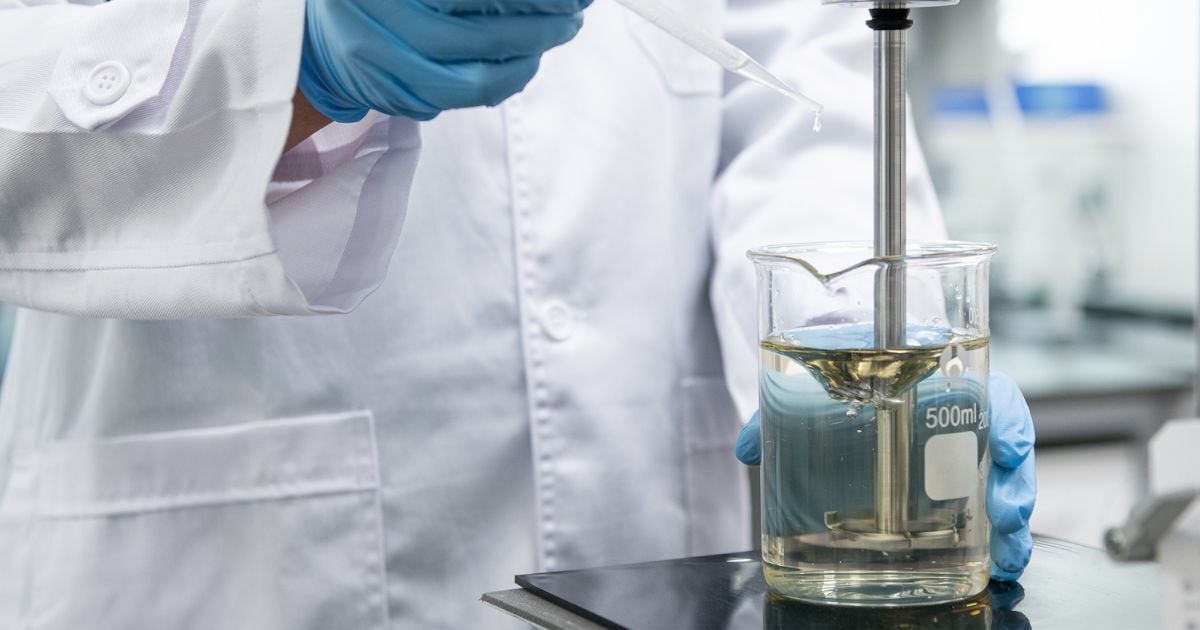
If your mixing results feel inconsistent or you keep switching equipment without resolving the problem, the issue is usually not the equipment, but the mixing method. When comparing magnetic, mechanical, and dispersing stirrers, the goal is to match your material's behavior with the tool's motion, torque, and shear.
Once you understand that difference, choosing the right setup becomes much more straightforward as you scale.
What’s the Difference Between Magnetic, Mechanical, and Dispersing Mixers? (It Comes Down to Force)
The difference comes down to how much force your process needs and what kind of mixing you are trying to achieve.
Here is the breakdown:
- Magnetic stirrers → low-torque, low-shear mixing
- Mechanical (overhead) stirrers → higher torque, controlled mixing
- Dispersers → high-shear, aggressive mixing for particle breakdown
Each tool is built for a different type of mixing problem. They are not interchangeable, even if they all “mix.”
Choosing the right one comes down to matching motion type, torque demand, and shear sensitivity to your process.
Magnetic Stirrers
Magnetic stirrers are among the most common tools in laboratory mixing equipment. They are simple, reliable, and ideal for light-duty mixing.
How Magnetic Stirrers Work
A magnetic stirrer uses a rotating magnetic field to spin a stir bar inside your vessel.
- The base creates the magnetic rotation.
- The stir bar follows that motion inside the liquid.
- There is no direct mechanical contact between the motor and the fluid.
This setup keeps the system clean and reduces the number of moving parts that come into contact with your sample.
When To Use Magnetic Stirrers
Magnetic stirrers perform well when resistance is low, and consistency is easy to maintain.
- Low-viscosity liquids – Thin fluids move easily, so the stir bar can keep up without slipping.
- Small volumes – Smaller batches stay within the limits of magnetic coupling.
- Clean, closed systems – No shafts or seals mean fewer contamination risks.
You will often see these used for basic sample preparation or for simple liquid-mixing solutions, where gentle motion is sufficient.
Where Magnetic Stirrers Struggle
Magnetic stirrers reach their limit when resistance increases.
- High viscosity – Thick fluids cause the stir bar to decouple or stall.
- Large volumes – As volume increases, so does the force required to keep material moving.
- High torque demand – The system cannot generate enough force to handle heavy or complex mixtures.
If you notice inconsistent mixing, slipping, or uneven results, it is a sign that the process has moved beyond what a magnetic stirrer can handle.
For a deeper breakdown, see Is a Magnetic Stirrer Enough? How to Know for Your Process.
Mechanical Stirrers
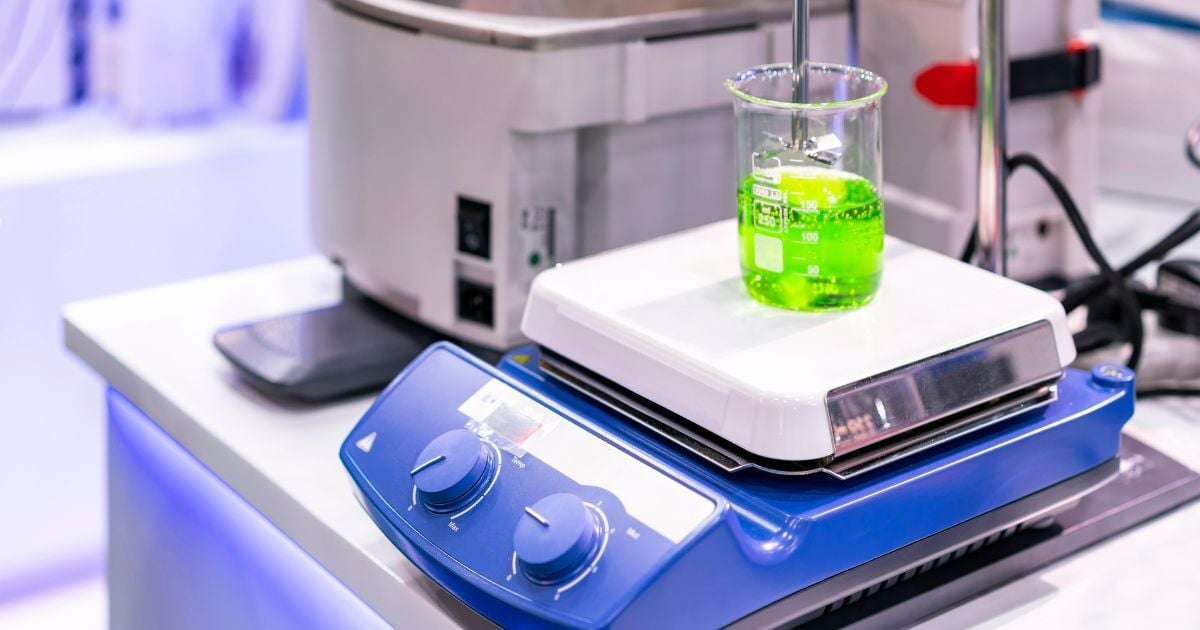
Mechanical stirrers (also called overhead stirrers) bridge the gap between light mixing and more demanding processes. They give you direct control over speed, force, and consistency, making them among the most flexible options in laboratory mixing equipment.
How Mechanical Stirrers Work
A mechanical stirrer uses a motor to drive a shaft and impeller directly into the fluid.
- The motor applies a consistent rotational force.
- The shaft transfers that force into the vessel.
- The impeller moves the material based on its shape and speed.
You can adjust both speed and torque, allowing you to match the mixing action to your process.
When To Use Mechanical Stirrers
Mechanical stirrers are the right choice when your process requires greater control and force than a magnetic stirrer can provide.
- Medium- to high-viscosity fluids – Thicker materials require steady torque to keep moving.
- Larger batch sizes – More volume increases resistance, which requires more power.
- Applications requiring controlled mixing – Useful when consistency, repeatability, or specific flow patterns matter.
This makes them a go-to option for many liquid-mixing applications and more demanding sample-preparation equipment setups.
Where Mechanical Stirrers Struggle
Mechanical stirrers are versatile, but they are not built for every mixing scenario.
- High-shear requirements – Mechanical stirrers do not generate enough shear to break down particles or fully disperse phases.
- Improper impeller selection – If the design does not match your process, you may see poor circulation, dead zones, or uneven mixing.
- Open-system limitations – Because they require a shaft entering the vessel, they may introduce contamination risks or require sealing in more sensitive applications.
If your process requires particle size reduction, true homogenization, or highly uniform dispersion, a mechanical stirrer will fall short.
Dispersers
Dispersers are built for one thing: breaking materials down and forcing them to blend at a microscopic level.
How Dispersers Work
Dispersers use high-speed rotation to create intense shear forces within the fluid.
- The mixing head spins at high velocity.
- Materials are pulled into a high-energy zone.
- Particles are broken apart and redistributed.
This is what drives homogenization. Instead of just moving liquid, dispersers actively change particle size and distribution.
When To Use Dispersers
High-shear dispersers are used when your goal is mixing uniformity at a finer level.
- Emulsions and suspensions – Helps keep different phases evenly distributed.
- Breaking down solids into liquids – Reduces particle size so materials fully integrate.
- Applications requiring uniform dispersion – Critical when consistency affects performance or stability.
These are common use cases for high-shear dispersers in more advanced laboratory mixing equipment setups.
Where Dispersers Struggle
Dispersers are powerful, but that comes with trade-offs.
- Can damage shear-sensitive materials – Some structures break down too much under high shear.
- Higher energy input and heat generation – The process can raise the temperature, potentially affecting your sample.
If your process needs gentle handling or precise structure control, high-shear mixing is too aggressive.
Side-by-Side Comparison
|
Mixing Tool Type |
Motion Type |
Torque Capability |
Shear Level |
Ideal Applications |
|
Magnetic Stirrer |
Gentle rotation |
Low |
Low |
Low-viscosity liquids, small volumes |
|
Mechanical Stirrer |
Forced circulation |
Medium to high |
Low to moderate |
Medium–high viscosity fluids, larger batches |
|
Disperser |
High-speed shear zone |
High |
High |
Emulsions, suspensions, particle breakdown |
How to Choose the Right Mixing Tool for Your Process

Choosing between mixing tools comes down to one thing: how your material behaves under motion.
Here’s how to evaluate the tool you need.
Step 1: What Are You Mixing?
Start with the material itself.
- Is it a single liquid or multiple phases?
- Are you working with powders, solids, or just fluids?
- Does the structure need to stay intact or change?
This tells you whether you are blending, suspending, or running a homogenization process.
Step 2: How Much Resistance Does It Create?
Next, look at how the material responds when you try to move it, since this determines your torque requirement.
- Thin and free-flowing → low resistance → magnetic stirrer is often enough
- Thick, sticky, or multi-phase → higher resistance → mechanical stirrer becomes necessary
Step 3: What Outcome Do You Need?
Now define what success looks like.
- Blending (gentle, uniform mixing) → Magnetic stirrer
- Controlled mixing (consistent movement, higher viscosity) → Mechanical stirrer
- Particle breakdown or full dispersion → Disperser
If your process requires breaking materials down (not just moving them), this is where high-shear dispersers work best.
Step 4: Check for Shear Sensitivity
One last filter: Can your material handle shear?
- If yes → dispersers are an option
- If no → stay with controlled mixing (magnetic or mechanical)
Choose the Mixing Method and Not the Machine
Magnetic stirrers, mechanical stirrers, and dispersers are not upgrades of one another. They are tools designed for different mixing problems. If you focus on how your process responds to motion, resistance, and shear, you will build a mixing setup that actually works the way you need it to.
Explore USA Lab Equipment’s selection of magnetic stirrers, mechanical stirrers, and dispersers to compare options and find the right mixing solution for your process.