
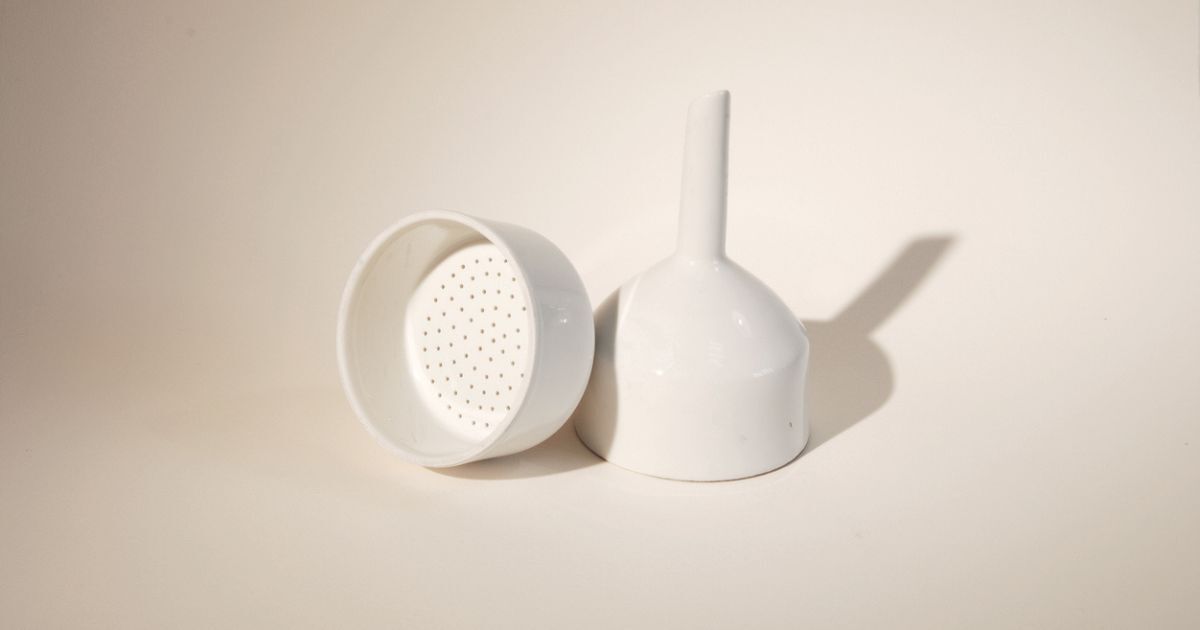
If your Buchner funnel is slow, inconsistent, or not giving you clear results, the problem is usually the filter media, not the funnel.
What Is a Buchner Funnel?
A Buchner funnel is a filtration apparatus designed to separate solids from liquids by vacuum rather than gravity.
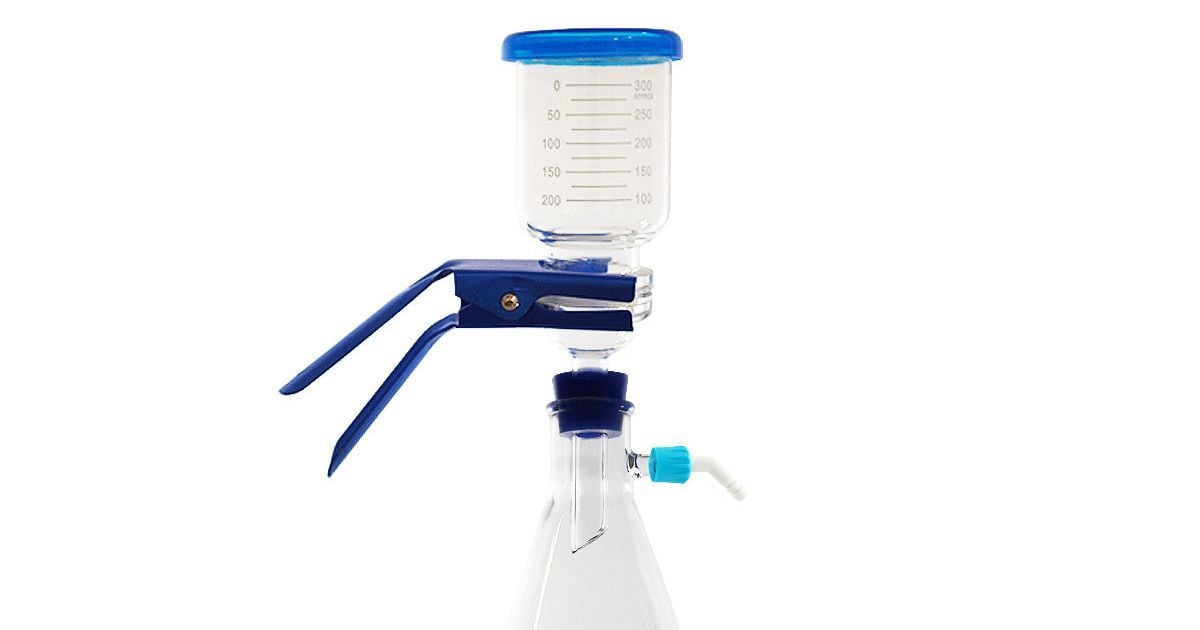
Instead of waiting for liquid to slowly drip through a filter, a Büchner funnel uses reduced pressure to pull the liquid through filter media much faster. The solid remains on the filter, while the liquid passes into a collection flask below.
How a Buchner Funnel Works
To get consistent results, it helps to understand how the filtration system works.
The Role of Vacuum in Filtration
In a standard setup, vacuum pressure does the heavy lifting. It pulls liquid through the filter media instead of relying on gravity, speeding up separation (especially for fine particles or thicker solutions).
That added force is what makes vacuum filtration more efficient. You get faster flow and a cleaner split between solid and liquid.
Components of a Complete Filtration Setup
For the system to work properly, each part needs to do its job:
- Funnel – Holds the filter media and directs flow
- Filter paper or media – Captures solids and controls separation
- Flask and vacuum source – Creates the pressure difference that drives the process
Only one of these parts actually controls what gets filtered: the media. The rest of the system supports it.
Why Filter Media Matters More Than the Funnel
It is easy to focus on the funnel, but in most setups, the funnel is not doing the actual work. The funnel is the support structure that holds everything in place and connects your system.
Filter media is where particles are captured, flow is controlled, and where filtration either works or fails. If your results are slow, inconsistent, or unclear, the issue is usually the media, since problems come from a mismatch between the media and the material you are working with.
Understanding Filter Paper and Filter Media

You can have the right funnel and a strong vacuum, but if your filter media is not matched to your material, the results will fall apart.
What Filter Paper Actually Does
Filter paper does more than just “catch solids.” It controls how the entire process behaves.
- Controls particle retention – determines what stays and what passes through
- Affects flow rate – tighter papers slow things down, more open papers move faster
- Impacts clarity – finer media leads to cleaner filtrate
If your paper is too coarse, particles slip through. If it is too fine, the flow slows or clogs. That balance is what you are really choosing.
Typical Filter Paper Options
To make this more concrete, consider a common example.
A medium-grade qualitative filter paper with around 11 µm particle retention is often used for everyday lab filtration. It provides a balance between retention and flow, making it useful for general liquid clarification and routine sample prep.
This type of filter paper typically has:
- Moderate flow speed – not too slow, not too fast
- Low ash content – useful when residue needs to stay minimal
- Pre-cut sizing – helps ensure consistent setup and fit in the funnel
It is not the right choice for every application, but it is a useful baseline.
If your filtration needs are more precise, you would move to a finer grade, like a 2 µm or 1–3 µm filter paper, which is designed to capture very small particles and improve clarity. However, the flow will be slower.
If speed is more important than clarity, you might go coarser, like a 20 µm fast-grade paper or even a 30–50 µm range, which allows liquid to pass through more quickly but will not retain fine particles as effectively.
Other Filter Media
Filter paper is common, but it is not your only option. Depending on your application, other media can give you better performance:
- Stainless steel filtration components – durable, reusable systems designed for repeated or higher-volume filtration
→ often paired with mesh screens or other media for more demanding setups
- Sintered glass – built-in porosity, reusable, and consistent flow
→ often used when you want a fixed pore structure without replacing paper each run
- Membranes – very precise filtration for fine particles or sensitive work
→ useful when clarity and exact particle retention matter more than speed
Each type changes how particles are captured and how liquid flows. That is why filter media is both a material choice and a performance decision.
Matching Media to Particle Size and Chemistry
This is where most filtration decisions either work or start to break down.
Particle Size: Retention vs Flow
Every filtration choice comes down to a tradeoff.
- Smaller pores – better retention, but slower flow
- Larger pores – faster flow, but lower precision
This is where porosity and permeability come into play.
- Porosity controls what gets captured.
- Permeability controls how easily liquid moves through.
If you go too fine, you get better clarity but slower flow. If you go too open, you gain speed but lose filtration efficiency. So your goal is to match your filter media to your particle size.
Chemical Compatibility
Not all media can handle all conditions. You need to consider:
- Solvents that may weaken or dissolve the media
- Acids or reactive compounds that can break it down
- Temperature sensitivity that affects structure and performance
If the media degrades, your results will be inconsistent and unreliable.
Viscosity and Flow Resistance
Thicker liquids behave differently.
- High viscosity slows movement through the media.
- Vacuum alone cannot always compensate for resistance.
That means you may need more permeable media, adjusted vacuum strength, or a different setup altogether. If the flow feels unusually slow, it is often a viscosity issue and not just a pore-size problem.
When you align particle size, chemistry, and flow conditions, filtration becomes much easier to control.
Choosing the Right Buchner Funnel Material
Once your media is properly matched, the funnel material becomes a supporting decision.
It still matters, but it will not fix filtration issues on its own if the media is mismatched.
Glass Buchner Funnels
Glass is one of the most common choices in lab settings.
- Strong chemical resistance – works with a wide range of solvents and reagents
- Clear visibility – lets you monitor flow, buildup, and filtration behavior in real time
This makes glass a solid option for general lab work and situations where you want to see what is happening during filtration.
Ceramic Buchner Funnels
Ceramic funnels are a more traditional option for vacuum filtration.
- Durable under vacuum – handles repeated use without warping
- Stable structure – maintains consistent performance over time
They are often used in setups where reliability matters more than visibility.
Stainless Steel Options
Stainless steel is built for more demanding environments.
- High strength and longevity – stands up to heavy or repeated use
- Resistant to mechanical wear – good for industrial or high-throughput workflows
These are typically used when durability and long-term performance are the priority.
It Starts with the Right Filter Media
When you match media to particle size, chemistry, and flow conditions, filtration becomes faster, cleaner, and easier to control. When those factors are misaligned, problems occur no matter what equipment you use.
Explore USA Lab’s filtration solutions – from Büchner funnels to filter paper and stainless steel systems – to build a setup that matches your process and delivers consistent results.